
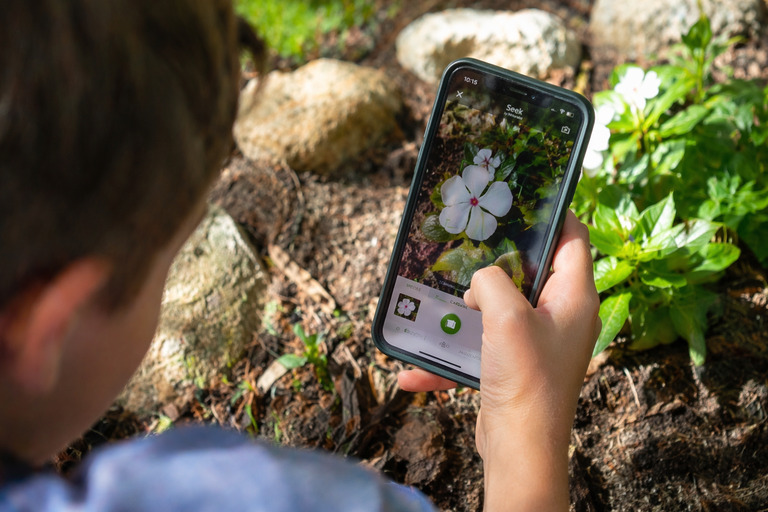
You probably won’t hear me talk a lot about apps. Because if you’ve been around here for a while, you know I’m a big believer in getting kids outside—observing, exploring, and interacting with the real world. But I’m also not anti-technology.
When used intentionally, technology can actually support outdoor learning in a really meaningful way.
Not replace it.
Not take over.
Just support it.
A Simple Way to Think About It
Think of these apps as a tool—not the experience.
They’re there to:
- spark curiosity
- help answer questions
- deepen what kids are already noticing
But the real learning? That happens outside.
Outdoor Learning Apps to Explore 📱
Below are some of my favorite apps, grouped in a way that makes them easy to use depending on what your child is interested in.
🌌 Sky & Space Apps

Great for evenings, camping, or just stepping outside and looking up.
- Night Sky (Free + Paid) – Point your device at the sky to instantly identify stars, planets, and constellations in real time.
- SkyView Lite (Free) SkyView (Paid) – A simple, kid-friendly way to explore the night sky by identifying celestial objects through your camera.
- Star Walk (Free + Paid) – An AR stargazing app with rich visuals that may appeal more to older kids.
- SkySafari (Paid) – A powerful astronomy app with deeper features, best for older kids or families who want to dive deeper.
🔍 Nature Identification Apps
- Seek by iNaturalist (Free) – A kid-friendly app that identifies plants and animals instantly with no account required.
- iNaturalist (Free) – A more advanced version that allows users to record and share observations with a global science community.
🐦 Birding Apps
Great for quiet observation and building patience.
- Merlin Bird ID by Cornell Lab (Free) – Identifies birds by sound, photo, or description—super engaging for kids.
- Audubon Bird Guide (Free) – A detailed field guide with photos, sounds, and range maps.
- eBird (Free) – Tracks bird sightings and contributes to real scientific data—better suited for older kids.
🌿 Plant & Tree Apps
Ideal for walks, parks, and backyard exploration.
- LeafSnap (Free + Paid) – Identifies trees and plants using photos of leaves. Offers care guides and plant journal.
- PlantNet (Free) – A simple and effective plant identification app powered by a global database. Participate in citizen science.
🪨 Bugs, Fungi & More
-
For kids who love the tiny details.
- Picture Insect (Free + Paid) – Quickly identifies insects and provides simple information about them.
- Shroomify (Paid) – Helps identify mushrooms with guided questions—best for older kids with supervision.
- iTrack Wildlife Lite (Free) iTrack Wildlife Basic & Pro (Paid) – Identifies animal tracks and signs, great for deeper outdoor exploration.
- Rock Identifier (Free + Paid) – Quickly identifies stones, crystals, minerals, and gemstones and provides simple information about them.
🧭 Exploration & Adventure
For kids who love a sense of purpose outside.
- Geocaching (Free + Paid) – A real-world treasure hunt using GPS that gets kids moving and exploring.
- Adventure Passport (Free + Paid) – Encourages outdoor exploration through challenges, tracking experiences, and building a sense of adventure.
- NatureCraft – Nature Art Guide (Free + Paid) – Take a photo of a natural object (like a pinecone or leaf) and get creative ideas for turning it into nature-inspired art.
How to Use These Without Overcomplicating Things
It’s easy to feel like you need to turn this into a full activity. You don’t.
Here are a few simple ways to use these apps without taking away from the experience:
- Use them after your child notices something (“What do you think it is?” → then check)
- Keep it quick—a few minutes, not the whole time outside
- Let your child lead their curiosity
- Use it as a starting point, not the main event
🌿 Start Simple and Follow Their Curiosity
You don’t need apps to make outdoor time meaningful. But when used in small, intentional ways…
They can help kids:
- ask better questions
- notice more
- feel more connected to the world around them
And that’s really the goal.
If you’re looking for even simpler ways to get started outside…
👉 Check out 15 Simple Outdoor Science Prompts for Kids (No Prep Needed)
You can also explore the LMU Nature Journal & Educator’s Guide for guided prompts and easy ways to keep the learning going.