
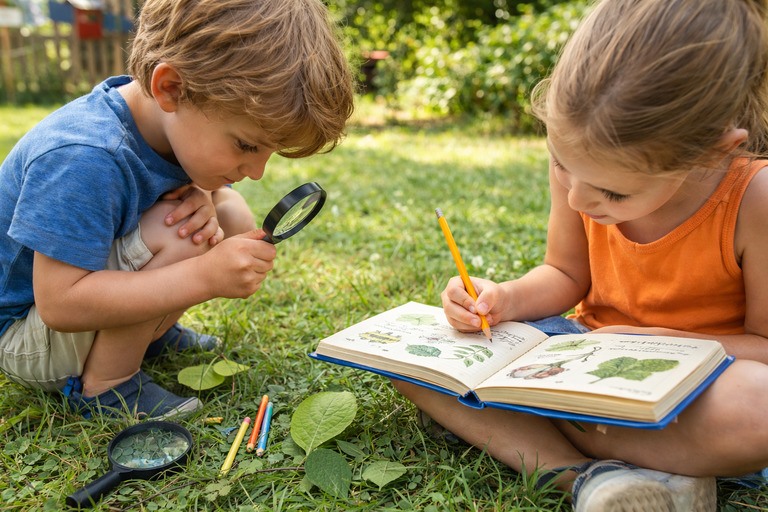
Getting Outside Doesn’t Have to Be Complicated
You want your kids to spend more time outside. You want them to be curious… to notice things… to ask questions. But sometimes, the hardest part is knowing what to do once you’re out there.
So, the questions start:
- “What should I have them look for?”
- “Is this even educational?”
- “How do I keep them engaged?”
Here’s the good news:
👉 You don’t need a lesson plan.
👉 You don’t need materials.
👉 And you don’t need all the answers.
You just need a simple starting point. That’s exactly where these prompts come in.
What Makes These “Science” Prompts?
These aren’t quizzes or worksheets. Instead, they’re invitations to:
- Notice
- Wonder
- Explore
- Record
After all, real science, especially for kids, starts with observation and curiosity. When children slow down and really look at the world around them, they naturally begin to think like scientists.
👀 Observe: Start with What You Notice
These prompts help kids slow down and pay attention to details.
- What do you notice about this leaf?
- Find three different textures outside. How do they feel?

- Look closely at the ground. What tiny things can you find?

🤔 Wonder: Ask Questions About the World
From there, curiosity begins to grow.
- Why do you think this plant is growing here?
- What do you think will happen to this leaf in a few days?
- Why are some areas wetter or drier than others?
🔍 Compare: Look for Similarities and Differences
In this way, comparing helps kids make sense of what they see.
- How are these two leaves the same? How are they different?
- Which area has more insects—the grass or the sidewalk edge?
- Compare a sunny spot and a shady spot. What’s different?
🎨 Record: Capture What You Notice
Recording helps children slow down even more and make their thinking visible.
- Draw something you see
- Make a simple sound map of what you hear
- Do a leaf rubbing and notice the details
🌱 Predict: Think About What Might Happen Next
Prediction builds deeper thinking and reasoning.
- What do you think will happen if it rains later?
- Which plant do you think will grow the fastest? Why?
- What might happen to this puddle over time?
Thinking Like a Scientist (Without the Pressure)
You might notice something important as you use these prompts. You’re not “teaching a lesson.” And that’s exactly the point.
When kids:
- observe closely
- ask their own questions
- make predictions
- record what they notice
They’re already doing the work of scientists. In fact, no script required.
Want to Turn This into a Simple Routine?
These prompts are a great place to start. From there, if you find your kids enjoying this kind of exploration, you can easily turn it into a simple, meaningful routine. I walk you through exactly how to do that here:
How to Start a Nature Journaling Routine with Kids (Without the Overwhelm)
Nature journaling gives kids a place to:
- keep their observations
- revisit their ideas
- see how their thinking grows over time
Keep It Simple (That’s Where the Magic Is)
You don’t need to do all 15 prompts. You don’t need to stay outside for hours. You don’t need perfect drawings or perfect answers.
Instead, start with one question. One moment. One small observation. Because when kids are given the space to notice and wonder, that’s where real learning begins.